Managing Risk Before It Becomes a Claim: The Role of Professional Indemnity in Construction Projects
As construction projects grow in complexity, strong governance, clear communication, and proactive risk management are essential. Discover how professional indemnity in construction projects helps protect consultants, clients, and project outcomes when challenges arise.
Categories:
Strong Projects Start with Strong Processes: Where Professional Indemnity Fits In
When a building project reaches completion, there’s often a collective sigh of relief. Construction projects inevitably come with their fair share of challenges — balancing budgets, coordinating multiple consultants, managing evolving timelines and making countless decisions along the way. Yet when the doors finally open, those challenges give way to something tangible: a space ready to be occupied, used and enjoyed. For clients and project teams alike, it’s a moment of well-earned satisfaction.
But sometimes the story doesn’t end there.
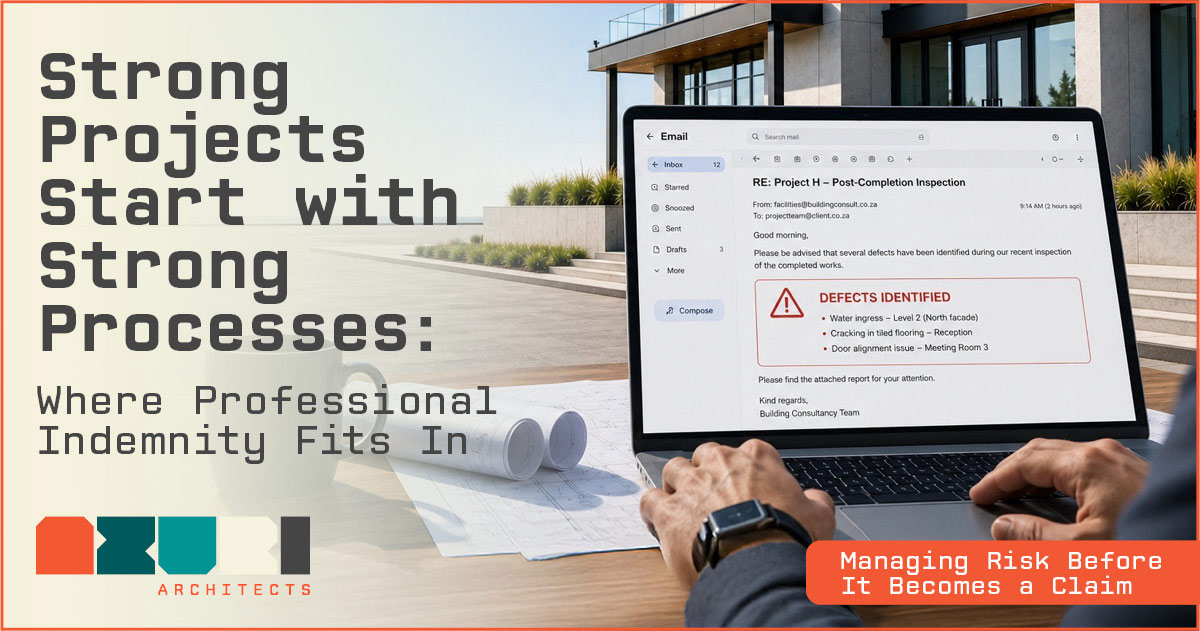
Six months later, a defect emerges. A year later, a dispute follows. The contractor points to the drawings. The consultant points to the contractor. The client wants answers.
Construction projects rarely unravel because of a single catastrophic mistake. More often, issues arise through a combination of decisions, assumptions, omissions and misunderstandings that only become apparent over time. Determining responsibility can quickly become complicated, particularly when multiple professionals, consultants and contractors have contributed to the final outcome.
This is where professional indemnity insurance enters the conversation.
While often viewed as a technical or administrative requirement, professional indemnity insurance plays an important role in protecting both professionals and their clients when disputes arise. More importantly, understanding how it works can help project teams better manage risk long before problems occur.
Risk Management First. Professional Indemnity Second.
The construction industry is becoming increasingly complex.
Projects are being delivered faster, budgets are under pressure and project teams often include a growing number of consultants, specialists and technical stakeholders. While these advances create opportunities, they can also increase exposure to risk.
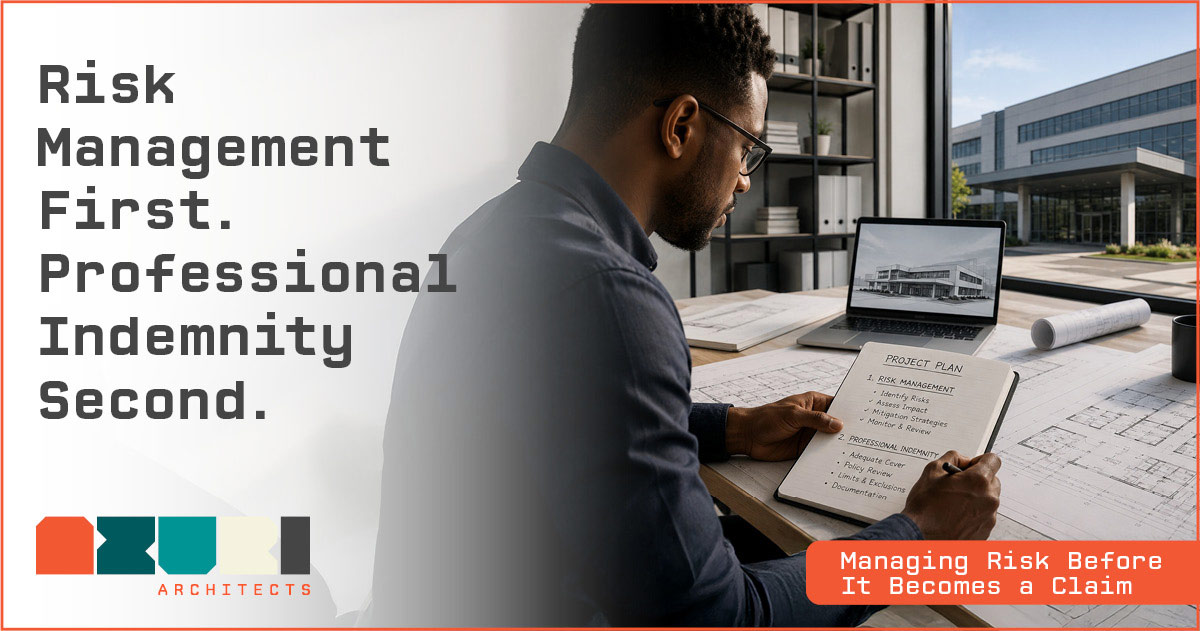
Managing that risk begins long before professional indemnity insurance is ever called upon. Good project governance, clear communication and well-defined responsibilities remain the first line of defence. Professional indemnity plays a different role: it provides an important safeguard when genuine professional errors or omissions occur despite those processes being in place. Understanding where one ends and the other begins is essential to reducing disputes and protecting everyone involved.
According to Aon’s Professional Indemnity State of the Market, recurring causes of professional indemnity claims in the built environment include defective designs, inexperienced professionals, design and budget overruns, inadequate site supervision, late notifications and poorly defined scopes of service.
What is particularly striking is that many of these issues do not stem from catastrophic failures.
Instead, they often arise from gaps in communication, coordination, documentation or project governance. A decision is not recorded. A responsibility is assumed rather than confirmed. A change is introduced without fully understanding its implications. Small issues accumulate until they become costly disputes.
In an environment where projects are increasingly fast-tracked and expectations continue to rise, understanding and managing these risks has become more important than ever.
What Clients Often Misunderstand About Professional Indemnity
Many clients understand that architects and consultants carry professional indemnity insurance, but there is often confusion about what that cover actually does.
One of the most common misconceptions is that professional indemnity insurance functions as a blanket guarantee against any project problem. In reality, professional indemnity insurance generally responds to claims arising from professional negligence, errors or omissions that result in financial loss to a third party.
This misunderstanding is not unique to South Africa. The Royal Institute of British Architects (RIBA) notes that clients often assume professional indemnity insurance covers any issue that arises during a project, when in reality policies contain defined limits, exclusions and conditions. Understanding these boundaries helps establish realistic expectations and reinforces the importance of clear contractual responsibilities from the outset.
Equally, clients sometimes assume that if something goes wrong on a project, someone’s insurance will automatically cover the cost. Construction projects rarely operate in such simple terms. Responsibilities are typically shared across architects, engineers, quantity surveyors, contractors and clients themselves, making it essential that roles and obligations are clearly defined from the outset.
Professional indemnity should therefore be viewed less as a warranty and more as a mechanism for accountability. It provides a pathway for legitimate claims to be investigated and resolved, helping to protect both professionals and the clients who rely on their expertise.
Professional indemnity can also become misunderstood during the design process itself. Some professionals will be familiar with comments such as, “You can propose that solution, but it’s your PI on the line if something goes wrong.” While often made in passing, this reflects a common misconception. Professional indemnity should not be used as a negotiating tool or substitute for collaborative decision-making. Good project outcomes rely on informed discussions, clearly allocated responsibilities and shared accountability — not the assumption that one party’s insurance can absorb every project risk.

What Professionals Often Misunderstand About Their Own Cover
The conversation is not only relevant to clients.
Many professionals assume that because they have a professional indemnity policy in place, they are adequately protected. However, having cover and having the right cover are not necessarily the same thing.
Keeping cover current is a critical part of effective risk management. Professional practices evolve over time. Services expand, project values increase and new areas of expertise are introduced. If insurance arrangements don’t evolve alongside the business, gaps in cover can emerge, leaving professionals exposed despite believing they are adequately covered.
Questions professionals should regularly ask include:
- Is the level of cover still appropriate for the size and complexity of projects being undertaken?
- Does the policy accurately reflect the services currently being provided?
- Are project records and documentation sufficient should a claim arise?
- Are potential claims being reported within the required timeframes?
Professional indemnity insurance is most effective when it complements a broader risk-management strategy rather than being treated as a once-a-year administrative exercise.
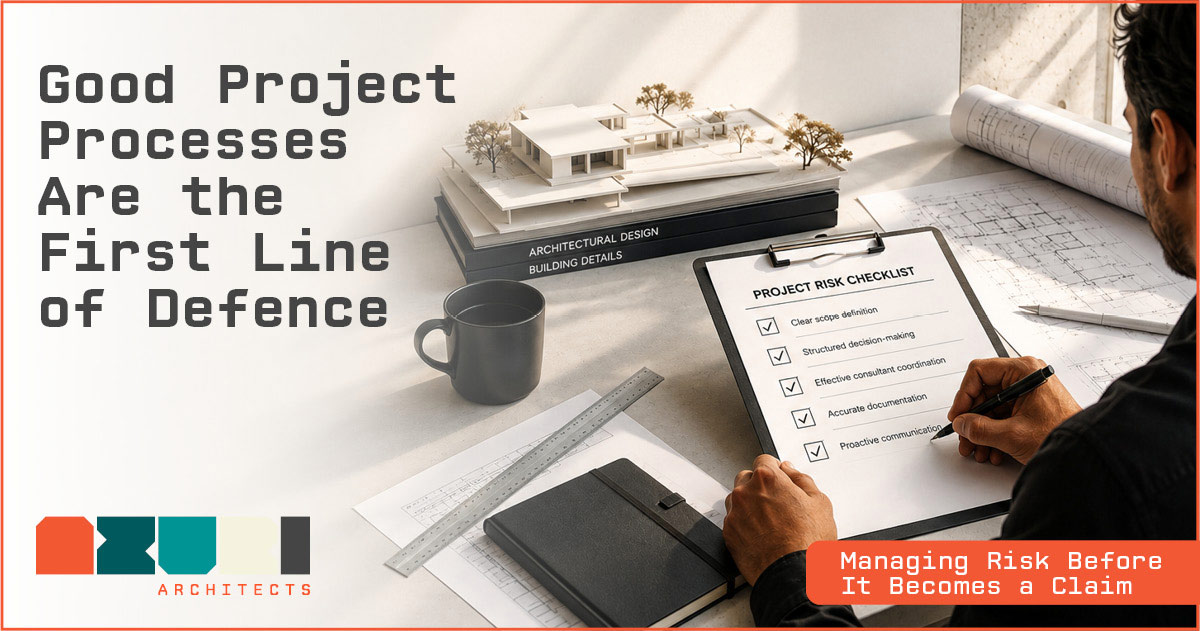
Good Project Processes Are the First Line of Defence
While professional indemnity insurance provides an important safety net, the ultimate goal is to reduce the likelihood of claims arising in the first place.
This is where project processes become critical.
Clear scope definition, structured decision-making, effective consultant coordination, accurate documentation and proactive communication all play an important role in reducing project risk. In fact, many of the recurring claim trends identified by Aon can be traced back to shortcomings in these areas rather than purely technical design failures.
These principles also reflect the broader standards promoted by professional bodies such as the South African Institute of Architects (SAIA), which emphasise professional responsibility, ethical practice and effective project management as fundamental to successful project delivery.
Strong project governance benefits everyone involved. Clients gain greater certainty around responsibilities and decision-making. Consultants work within clearly defined parameters. Contractors receive more accurate information. Project teams are better equipped to identify and resolve issues before they escalate.
In many respects, good project management and professional indemnity insurance work hand in hand toward the same objective: protecting projects, relationships and outcomes.
Good Risk Management Is a Shared Responsibility
Professional indemnity insurance is often discussed as an insurance issue. In reality, it is a project issue.
Clients need to understand how responsibility is allocated across project teams. Professionals need to understand the extent of their obligations and ensure that their cover remains aligned with the work they undertake. Everyone involved needs to recognise that effective risk management begins long before an insurance policy is ever called upon.
The strongest projects are not necessarily those that avoid challenges altogether. They are the ones that manage complexity transparently, document decisions clearly and maintain trust when unexpected issues arise. Professional indemnity insurance forms part of that framework, providing a mechanism for accountability when genuine mistakes occur, but it is only one piece of the puzzle.
Ultimately, the goal is not to rely on insurance. It is to create projects where responsibilities are understood, risks are identified early and decisions are managed carefully throughout the project lifecycle. When these fundamentals are in place, professional indemnity becomes what it should be: an important safeguard operating quietly in the background, supporting a process that has been designed to minimise risk from the outset.
Professional Indemnity in Construction: FAQs
Professionals can reduce risk by regularly reviewing whether their insurance cover matches the size and complexity of their projects, maintaining thorough project records, clearly defining responsibilities, documenting decisions, reporting potential claims promptly, and treating professional indemnity as one part of a broader risk management strategy.
Many claims do not result from major design failures. Instead, they often arise from defective designs, inadequate site supervision, poorly defined scopes of work, budget overruns, inexperienced professionals, late notifications, and gaps in communication or documentation. Small issues that are not properly managed can accumulate into costly disputes.
Good project governance helps prevent disputes before they happen. Clear communication, defined responsibilities, accurate documentation, consultant coordination, and structured decision-making reduce the likelihood of professional errors and misunderstandings. Professional indemnity insurance should be viewed as a safety net, not a substitute for strong project management.
No. A common misconception is that professional indemnity insurance automatically covers any issue on a project. In reality, policies have defined limits, exclusions, and conditions. Construction projects involve shared responsibilities between clients, architects, engineers, contractors, and consultants, so determining liability depends on the specific circumstances and contractual obligations.
Professional indemnity insurance protects architects, engineers, and other construction professionals against claims arising from professional negligence, errors, or omissions that result in financial loss. It is designed to support legitimate claims where professional advice or services have caused a problem, but it is not a guarantee against every issue that may occur during a construction project.