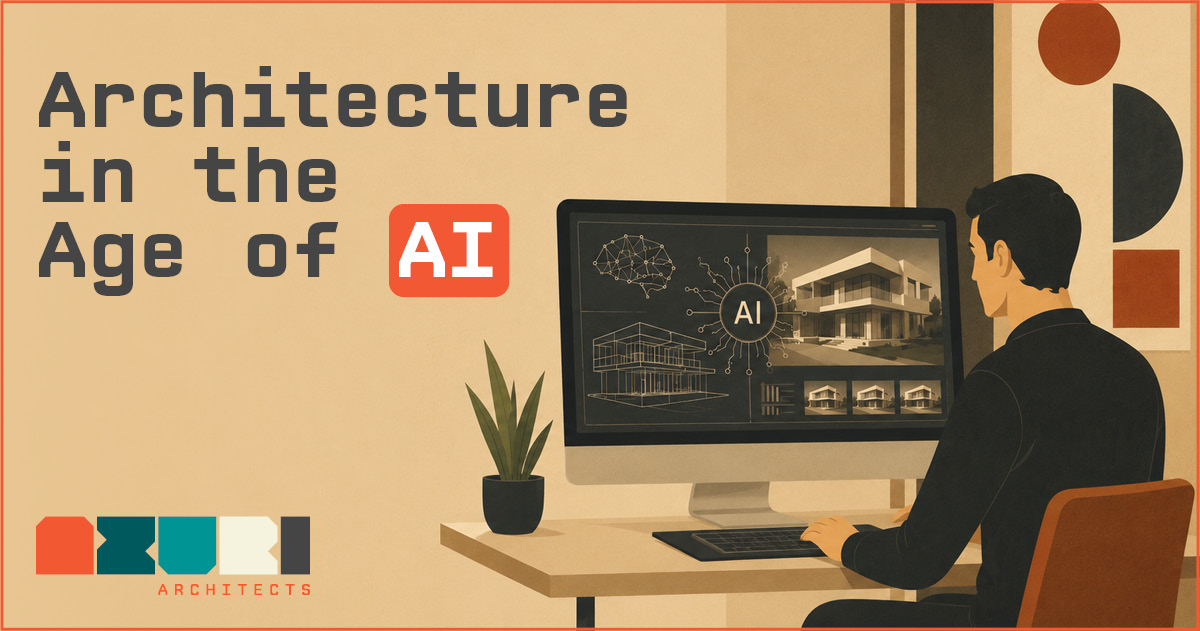
Architecture in the Age of AI
Explore the rise of human-machine architecture and how AI, robotics and retrofits are redefining comfort, efficiency and resilience in future South African and global buildings.
Categories:

Human-Machine Architecture: How AI and Robotics Are Reshaping Commercial and Public Spaces
We are entering a new era of design in which buildings must not only support the people who use them, but also the intelligent systems and autonomous machines that increasingly move, work, and interact alongside us. Automation is no longer confined to factories: hospitals, offices, retail spaces, logistics hubs and public amenities are already integrating robotics and AI-enabled systems into everyday operations.
As these technologies become more pervasive, architects face a profound design challenge: How do we create spaces that remain fundamentally human, while also enabling the efficient movement, charging, sensing and coordination required by intelligent machines?
This article introduces the opportunities and complexities of designing for a hybrid future – one in which people and robots share the built environment. A deeper dive into ethics, data protection and governance will follow in our next piece.
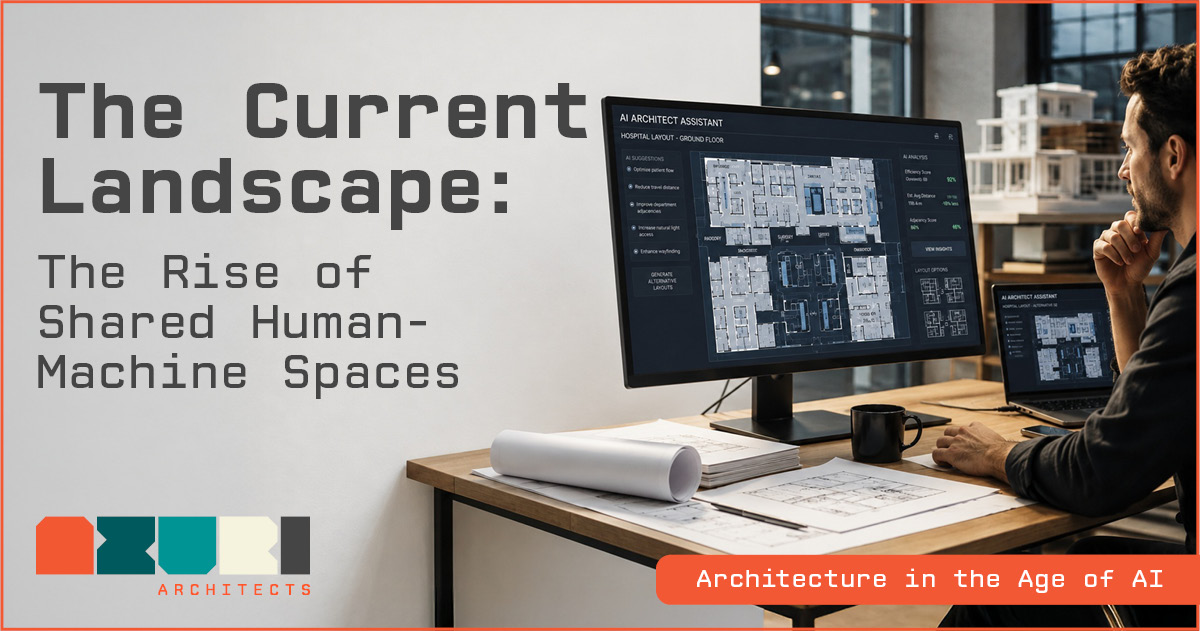
The Current Landscape: The Rise of Shared Human-Machine Spaces
Today’s buildings are still overwhelmingly designed for humans – human heights, human walking speeds, human sensory needs. Yet robots and AI systems have already begun inhabiting these environments, often in ways that reveal the limitations of our current design approach.
- Offices and commercial campuses integrate AI-powered security, robotic cleaning fleets, digital concierge desks and smart workplace management platforms.
- Retail and hospitality spaces trial robotic baristas, automated coffee counters and delivery bots.
- Hospitals deploy autonomous delivery carts, robotic surgical systems and UV-disinfection robots.
- Parking garages are beginning to transform into charging and docking hubs for electric and autonomous vehicles.
- Even public recreational spaces are adapting to drones, mobile kiosks and augmented reality overlays.
Despite this rapid technological adoption, most buildings lack the circulation clarity, material consistency, sensory predictability and infrastructural backbone that robots require. At the same time, many of these buildings also fall short of providing the comfort, intuitive navigation and sensory quality that humans need. The gap between what buildings are and what they need to become is widening for both groups, highlighting the need for environments that can support a broader diversity of users – human and machine alike.

Why Human + Machine Design Matters Now
Automation is no longer speculative. Estimates suggest that up to 45% of global work tasks could be automated by 2030, with workplace processes increasingly influenced by robotics and automation. In commercial environments, this shift is already influencing how offices are planned, how facilities operate and how people move through buildings – from autonomous deliveries and predictive maintenance to automated access control and hybrid collaboration systems. This convergence means our buildings must evolve to achieve three goals:
- Support human well-being: Biophilic cues, comfort, intuitive wayfinding, daylight and spatial warmth continue to be essential.
- Enable reliable machine operation: Robots need structured paths, consistent geometry, predictable lighting and strong connectivity.
- Reduce friction between the two: Poorly planned environments risk becoming unsafe or dysfunctional for both humans and machines.
Architecture must therefore act as the mediator, translating two different sets of needs into one coherent spatial experience.

Key Design Considerations for Human-Machine Buildings
Designing for a hybrid future means layering the needs of humans and machines without allowing one to diminish the other. Movement and circulation form the foundation: humans move intuitively while robots move algorithmically, so clear, predictable routes are essential to avoid collisions and maintain fluid workflow. In commercial buildings, this may include designing secondary back-of-house robotic pathways or ensuring shared corridors can safely support both human occupants and autonomous service devices.
Sensor-friendly environments are equally important. Robots interpret the world through LiDAR, depth cameras and infrared sensors, meaning material reflectivity, lighting quality and contrast play a functional role as well as an aesthetic one. Mirrored lobbies, glossy floors or dynamic lighting elements may require recalibration to avoid interfering with machine vision.
Electrical and digital infrastructure create the power and connectivity backbone of robot-enabled architecture. Discreetly integrated charging hubs, docking alcoves and cable-free zones support autonomous systems, while robust Wi-Fi, 5G and IoT networks ensure constant communication and navigation.
At a systems level, smart infrastructure – including digital twins and occupancy sensors – enables buildings to adapt dynamically to both human and machine behaviour, improving resilience and operational efficiency.
Yet even in highly automated environments such as corporate campuses, logistics hubs, and hospitals, the human-centred design layer must not be lost. People still navigate using light, texture, colour, spatial proportion and biophilic cues. Equally, machine-oriented design strategies – predictable geometry, consistent lighting, clear circulation paths – should be integrated without overpowering the human experience. The future lies not in prioritising one over the other, but in designing spaces where both can operate comfortably, safely and intuitively.

Retrofitting Existing Buildings: A Global Shift and a South African Reality
Retrofitting for a human–machine future is gaining traction across commercial real estate. Globally, office buildings, hotels and retail centres are adding IoT layers, upgrading digital networks, integrating service robotics and introducing predictive maintenance platforms – improvements that extend the life of existing assets while elevating tenant experience. Much of this work centres on integrating smarter building management systems, positioning retrofitting as a commercially viable path toward future-ready buildings.
In the United States, the E-ROBOT Prize (2021) encouraged innovators to use robots, drones and AI to retrofit existing buildings for deep energy efficiency – mapping leaks, automating insulation and transforming building performance through advanced automation.
Internationally, flagship commercial projects such as The Edge in Amsterdam – widely recognised as one of the world’s smartest office buildings – demonstrate how retrofitting can integrate IoT networks, advanced sensors and digital building management systems to create highly responsive, automation-enabled workplaces.
In South Africa, however, retrofitting meets a different set of realities. A shortage of specialised architectural and engineering expertise – exacerbated by brain-drain and limited training capacity – complicates the adoption of advanced technologies. Infrastructure volatility, from load-shedding cycles to inconsistent connectivity, further complicates the integration of autonomous systems.
Retrofitting here is less about installing “robot corridors” or automated docking stations overnight; it’s about building adaptable layers of technology within contexts that require resilience, creativity and a deep understanding of local constraints.
Recent analyses show that South African commercial real-estate owners are increasingly investing in retrofits – from HVAC, lighting and sensor upgrades to full smart-building systems – to improve energy performance, tenant comfort and resilience in a context of grid instability and rising tenant expectations. While these upgrades stop short of full robotics-ready design, they establish a foundation on which robot-ready retrofits could build.
Key Considerations for a Human-Machine Future
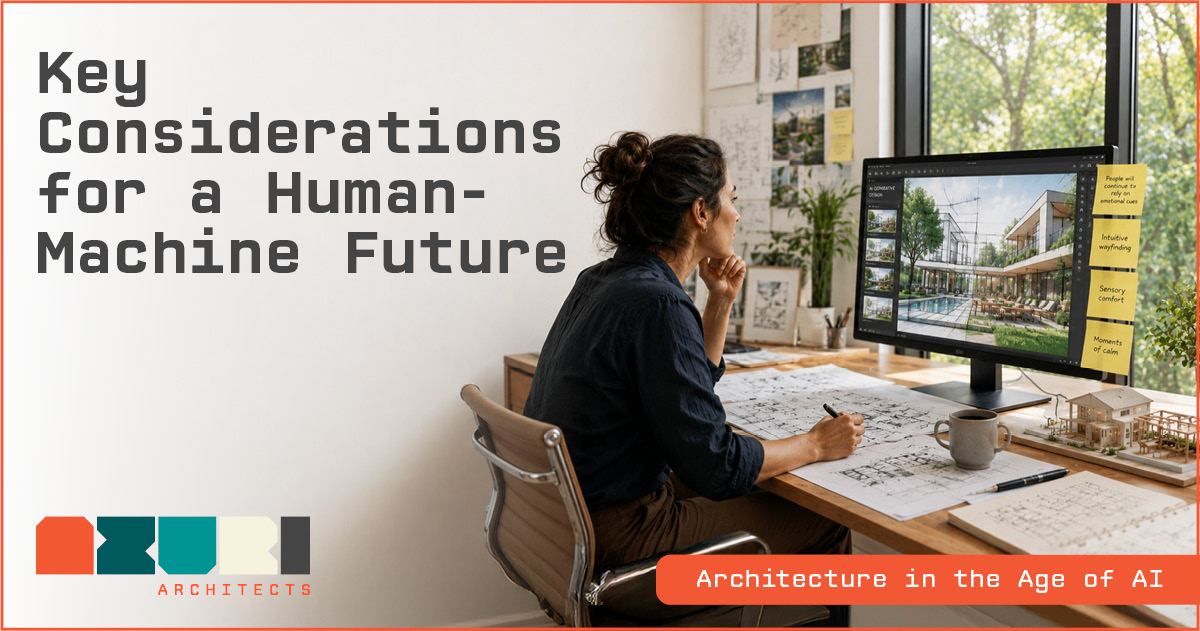
As automation becomes woven into more of our everyday environments, the question is not whether buildings will adapt, but how thoughtfully we guide that evolution. While robotics and AI will transform how spaces operate, human experience remains an essential anchor point. People will continue to rely on emotional cues, intuitive wayfinding, sensory comfort and moments of calm – qualities that shape our sense of belonging and safety.
At the same time, machines bring their own requirements: structured circulation paths, predictable geometry, reliable connectivity and access to digital infrastructure. These needs do not inherently conflict with human comfort; rather, they add a new layer of spatial thinking that architects can weave into environments already shaped by sensory and psychological considerations.
Principles such as flexibility, transparency, user choice and sensory richness will guide how these hybrid spaces evolve. They ensure that buildings remain places of comfort and connection, even as they become more intelligent and interconnected.
The deeper ethical questions – around data, privacy, transparency and trust – will be the focus of our next article, as we consider what it means to design for a future where technology becomes an integral and ever-present part of daily life.